
Management
Lies, Damned Lies, and Project Metrics (Part II)

[Part I is here.] In my previous post, I talked about the use of metrics in IT project management and the three qualities of an ideal metric: informative and preferably predictive, objective, and automated. The ideal set of metrics would tell you when your IT project is going to ship; these metrics would give you […]
Lies, Damned Lies, and Project Metrics (Part I)

When Capers Jones published Assessment and Control of Software Risks (Yourdon Press, 1994), he identified the most serious software risk in IT projects as “Inaccurate Metrics,” and the second most serious software risk as “Inadequate Measurement”. I remember being startled when I first read that back in 1995—they certainly weren’t what I would have chosen—and […]
A must-read for all software engineers and their managers
Thanks to Cat Mikkelsen [yes, ex-NeXT people, that Cat], I read this article. It’s written by Linds Redding, an art director and animator down in New Zealand who just passed away a few days ago. But it is very, very relevant to software engineering, particularly the ‘heroic’ model of software development. In it, he talks […]
WHS 2003 issues — looking for suggestions
This is actually a problem I’ve been dealing with — or, more accurately, ignoring and working around — for a few months, at least, so I thought I’d put a post up here to see if anyone has come up with an actual fix. Back in July 2010, I bought an Acer Aspire easyStore Home […]
The Thermocline of Knowledge
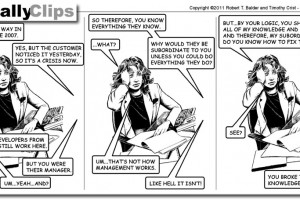
I’ve written here before about the thermocline of truth. The webcomic Partially Clips gives a different, humorous slant; click on the comic to view it in full size. ..bruce..